Showing posts with label gum disease. Show all posts

Saturday, June 6, 2020

Scaling and Root Planing for Gum Disease

Below is an excerpt from an article found on mouthhealthy.org

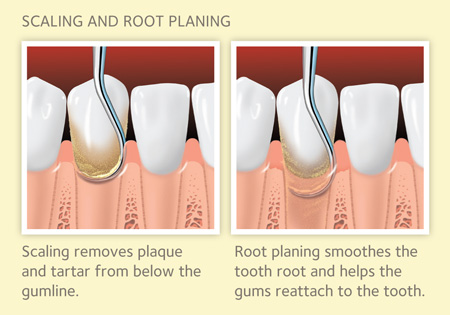
Scaling and root planing is a deep cleaning below the gumline used to treat gum disease.

Why Do I Need It?
Gum disease is caused by a sticky film of bacteria called plaque. Plaque is always forming on your teeth, but if they aren’t cleaned well, the bacteria in plaque can cause your gums to become inflamed. When this happens, your gums will pull away from your teeth and form spaces called pockets. Plaque then gets trapped in these pockets and cannot be removed with regular brushing. If untreated, gum disease could lead to bone and tooth loss.

If gum disease is caught early and hasn’t damaged the structures below the gum line, a professional cleaning should do. If the pockets between your gums and teeth are too deep, however, scaling and root planing may be needed.

A July 2015 study in the Journal of the American Dental Association finds that scaling and root planing is beneficial to patients with chronic periodontitis (gum disease that has advanced past gingivitis). Chronic periodontitis affects 47.2% of adults over 30 in the United States.

What Happens During Scaling and Root Planing?
This deep cleaning has two parts. Scaling is when your dentist removes all the plaque and tartar (hardened plaque) above and below the gumline, making sure to clean all the way down to the bottom of the pocket. Your dentist will then begin root planing, smoothing out your teeth roots to help your gums reattach to your teeth. Scaling and root planing may take more than one visit to complete and may require a local anesthetic.

After Care Tips
After a deep cleaning, you may have pain for a day or two and teeth sensitivity for up to a week. Your gums also may be swollen, feel tender and bleed.

To prevent infection, control pain or help you heal, your dentist may prescribe a pill or mouth rinse. Your dentist may also insert medication (subantimicrobial-dose doxycycline) directly into the pocket that was cleaned.

Your dentist will schedule another visit to see how your gums have healed and measure the depth of your pockets. If they have gotten deeper, more treatment may be needed.

Good dental care at home is essential to help keep gum disease from becoming more serious or recurring.  Brush your teeth twice a day with a soft brush, clean between your teeth daily, eat a balanced diet, avoid using tobacco and see your dentist regularly.

To read the entire article visit mouthhealthy.org
417 Water Street   
Wakefield, MA 01880    
(781) 245-7714  

Wednesday, May 6, 2020

Erupted Tooth: Pericoronitis Symptoms and Treatment

Below is an excerpt from an article found on crest.com

What is Pericoronitis?

Since wisdom teeth come in during late adolescence, pericoronitis is a form of gum disease that usually affects those between the ages of twenty and forty. Often the wisdom teeth are not able to come out fully due to a lack of room in the mouth, leading to a partially erupted tooth. The partial tooth eruption then leads to inflammation and infection of the soft tissue which surrounds it.

Symptoms of Pericoronitis

Symptoms often vary from one individual to the next and can occur chronically or acutely.
Those suffering from chronic or reoccurring pericoronitis may experience:
  • Mild discomfort around the affected area
  • Dull toothache
  • Bad breath
  • A foul taste in the mouth
Symptoms last for 1 to 2 days but continuously reappear without proper treatment.
Acute pericoronitis is usually caused by poor oral hygiene. This is relatively common since the wisdom teeth, located toward the back of the mouth, can be difficult to clean with manual brushing alone. Symptoms may include:
  • Pus discharge from affected area
  • Pain when swallowing
  • Extensive pain making it difficult to sleep
  • Swelling of the face
  • Swollen lymph nodes under the chin
  • Fever
Acute pericoronitis symptoms usually last about three to four days.

Treatment for Pericoronitis

The condition can be hard to treat due to the gum flap which has resulted from the partially erupted tooth. Often, the issue won’t go away completely until the tooth fully erupts from the gum line, or the tooth/soft tissue has been removed.

For mild cases, a dentist may recommend the following treatments:
  • Comprehensive cleaning
  • Removing any food, debris, or residue trapped inside the gum flap
  • Draining of the pus to reduce inflammation
  • Rinsing with a fluoride mouthwash containing an antibacterial agent such as CPC (Cetyl-pyridinium chloride) or salt mixture 
  • Antibiotics to manage the infection 
As with any form of gum disease, you should always follow a thorough oral care routine of brushing twice a day and flossing at least once. If your symptoms persist, see your dental professional right away. It is crucial to treat any sign of infection as soon as possible before it spreads to other areas of the mouth and jawline.

To read the entire article visit crest.com

417 Water Street   
Wakefield, MA 01880    
(781) 245-7714  

Sunday, September 15, 2019

Gum Pain Causes, Relief and Treatments


What Causes Painful Gums?

If you experience painful gums when you eat, drink, brush, or floss, you may be wondering what’s causing it and how you can treat it. Painful or bleeding gums can be caused by improper brushing or flossing techniques, gum disease, chemotherapy, tobacco use, or certain hormonal changes. It is very common for gum disease to lead to pain and bleeding, so resolving the problem is an important part of keeping your gums healthy. Your gums provide the overall support for your teeth and the basis of a healthy mouth, and if not properly cared for, early gum disease can progress to other serious oral health problems.

Below are several different causes of gum pain. Being familiar with these causes of gum pain can help you talk to your dental or medical professional when they’re diagnosing the cause of your discomfort.

  • Canker Sores: These are painful ulcers found in your mouth that can cause serious gum pain. Canker sores can be caused by stress or injury to the tissue in your mouth, or an underlying health condition such as an impaired immune system, nutritional deficiencies, or gastrointestinal disease.
  • Cuts or Abrasions: Gum pain can often be caused by a simple cut or abrasion. Braces or other dental hardware such as dentures or retainers can irritate the tissue and cause gum pain.
  • Gum Disease or Infection: Gum pain associated with sensitive or bleeding gums is often caused by gum disease or gum infection. The mildest form of gum disease, gingivitis, affects approximately one in two American adults and can cause chronic gum pain and sensitivity. If not treated properly by removing plaque from the teeth and around the gum line, gingivitis can progress to more serious gum infection.
  • Sinus Infection: A sinus infection, otherwise known as sinusitis, occurs when the tissue lining of your sinuses is swollen or inflamed, and can lead to sinus gum pain. Sinuses are normally filled with air, but when they become filled with fluid, germs can grow and lead to infection. Approximately 37 million Americans suffer from sinusitis each year, so sinus gum pain and dental pain are very common. 

If you notice any of these symptoms along with gum pain, you may want to consult with a medical professional to confirm the diagnosis and get treatment recommendations. Regardless of where your gum pain is located or its cause, chances are you’ll want to address it quickly.

Gum Pain Relief and Treatments


Gum pain can manifest in different ways. Some people experience gum pain in a single area of the gums, while others suffer from gum pain throughout their mouths. If you don’t take good care of your gums, they can deteriorate, become inflamed, infected, cut or even suffer from disease.

While there are many causes for tooth and gum pain, the treatment for most causes is pretty standard. Implementing an effective oral hygiene routine will most often help improve the health of your gums.  

A few gum pain remedies include: 


Other ways to reduce gum pain may include avoiding the use of tobacco, improving your nutrition, or reducing stress in your life. These important steps combined with an effective oral hygiene regimen can help bring your gums back to good health.
To read the entire article visit crest.com


417 Water Street   
Wakefield, MA 01880    
(781) 245-7714  

Sunday, March 17, 2019

What are the Stages of Gum Disease?

What is Gum Disease?

Gum disease is an inflammation of the gums that can progress to affect the bone that surrounds and supports your teeth. It is caused by the bacteria in plaque, a sticky, colorless film that constantly forms on your teeth. If not removed through daily brushing and flossing, plaque can build up and the bacteria infect not only your gums and teeth, but eventually the gum tissue and bone that support the teeth. This can cause them to become loose, fall out or have to be removed by a dentist.
There are three stages of gum disease:

  • Gingivitis: this is the earliest stage of gum disease, an inflammation of the gums caused by plaque buildup at the gumline. If daily brushing and flossing do not remove the plaque, it produces toxins (poisons) that can irritate the gum tissue, causing gingivitis. You may notice some bleeding during brushing and flossing. At this early stage in gum disease, damage can be reversed, since the bone and connective tissue that hold the teeth in place are not yet affected.
  • Periodontitis: at this stage, the supporting bone and fibers that hold your teeth in place are irreversibly damaged. Your gums may begin to form a pocket below the gumline, which traps food and plaque. Proper dental treatment and improved home care can usually help prevent further damage.
  • Advanced Periodontitis: in this final stage of gum disease, the fibers and bone supporting your teeth are destroyed, which can cause your teeth to shift or loosen. This can affect your bite and, if aggressive treatment can't save them, teeth may need to be removed.

Read the rest of the article at Colgate.com to learn more about how to know if you have gum disease and how gum disease is treated. 


The above article is from: Colgate.com

417 Water Street   
Wakefield, MA 01880    
(781) 245-7714  

Tuesday, February 5, 2019

Diabetes and Your Mouth # 2: Control Diabetes to Keep Your Smile

Well-controlled diabetes contributes to a healthy mouth. If you have poorly controlled or high blood sugar, your risk increases for dry mouth, gum disease, tooth loss, and fungal infections like thrush. Since infections can also make blood sugar rise, your diabetes may become even harder to control. Keeping your mouth healthy can help you manage your blood sugar.

The above article is from: WebMD.com

417 Water Street   
Wakefield, MA 01880    
(781) 245-7714